Revision Knee Replacement
Although today’s implants are designed to last many years, it’s possible When a knee replacement no longer functions correctly, revision surgery is often required. During this procedure, a surgeon replaces the old device with a new one. Revision surgery isn’t something to take lightly. It’s more complicated than a primary (or initial) total knee replacement (TKR) and entails many of the same risks.
Why Revision Surgery Is More Complicated Than Initial Surgery
Doesn’t provide the same lifespan as the initial replacement (usually about 10 years rather than 20).
The accumulated trauma, scar tissue and mechanical breakdown of components lead to diminished performance. More susceptible to complications.
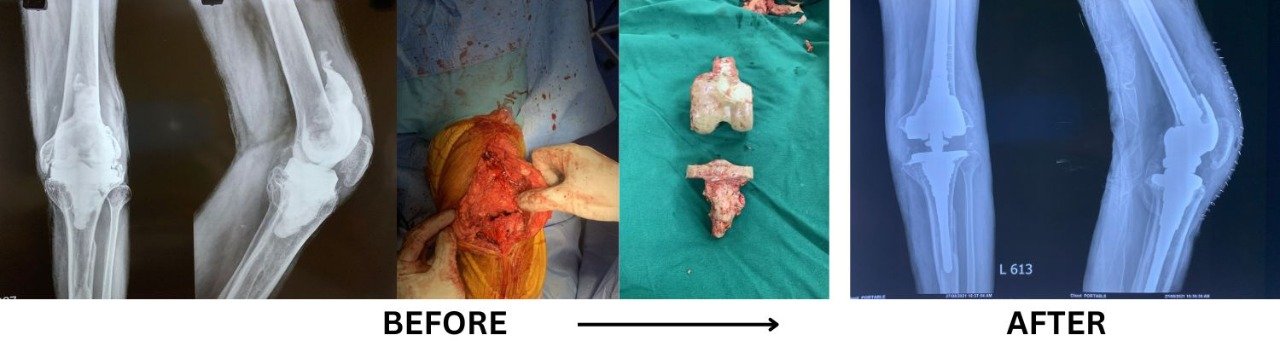
Typically more complex than the original knee replacement surgery because the surgeon must remove the original implant, which would have grown into the existing bone.In addition, once the prosthesis is removed, there is less bone remaining.
In some instances, bone graft — transplanting a piece of bone transplanted from another part of the body or from a donor — might be required to support the new prosthesis.
A bone graft adds support and encourages new bone growth.
However, the procedure requires additional preoperative planning, specialized tools, and greater surgical skill.
The surgery takes longer to perform than a primary initial knee replacement.
If A Revision Surgery Is Necessary, You’ll Experience Specific Symptoms.
Diminished stability or reduced function in the knee.
Increased pain or an infection (which usually occurs soon after the initial procedure).
A bone fracture or outright device failure.
In other cases, bits and pieces of the prosthetic device may break off and cause tiny particles to accumulate around the joint.
Reasons For a Revision
- Infection
- Trauma
- Instability (loose ligaments holding the knee stable)
- Implant dislocation
- Fractures
- Stiffness
What Happens During Knee Revision Surgery?
Knee replacement revision surgery for trauma or fracture.
( broken bones around the implant)
Knee replacement revision surgery for infection.
In some cases of infection, bacteria can be washed out, antibiotics given, and metal implants can be left in place. Otherwise, the implant must be removed, infected body matter must be cut out or debrided, and a spacer must be placed until the area is clear of infection. At a later date, your surgeon will insert a new permanent implant.
Knee replacement revision surgery for dislocation
Wear and tear leading to loosening can easily occur over time. In a process called aseptic loosening, the connection between the bone and implant breaks down as the body rejects the foreign particle. Usually, removal of loosened bone particles, medication and repositioning of the implant helps this complication.
Knee replacement revision surgery for instability or stiffness
Ligaments around the knee can become loose and unstable. Sometimes treatment can be nonsurgical, like physical therapy and bracing. Otherwise, soft tissue tightening can improve stability. Sometimes scar tissue can limit the range of motion, causing stiffness. If the scarring is too extensive, revision surgery to get rid of the excessive scar tissue may be needed.
Dr. Sanjeed Pujary
Consultant Orthopaedic & Joint Replacement Surgeon
MBBS, MS (Orthopaedics), F.I.H.K.A,
Knee & Hip replacement surgeon, Trauma Surgeon
+91-98922 88912 | drsanjeedpujary@gmail.com